|
—LŒÀ‰ïŽÐƒeƒNƒm�Eƒ�ƒWƒbƒN |
 |

|
‚¨–â‚¢�‡‚킹EmailƒAƒhƒŒƒX |
|
|
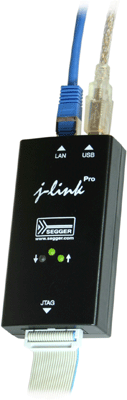
J-Link ARM Pro is a refined version of the regular J-Link. It has an Ethernet interface in addition to the USB interface, as well as two additional LEDs which are used as hardware status indicators. It connects via Ethernet or USB to the Windows (2000/XP/Vista) PC host. J-Link ARM Pro is fully compatible with J-Link ARM and can be used "out-of-the-box". J-Link ARM Pro uses DHCP per default. The built-in webserver makes manual configuration easy and convenient. Ethernet allows using the emulator far away from the PC in a development or production environment; download and debugging speed is higher and Ethernet provides electrical isolation from the PC.
�@ Wizard — Mician UwaveMician (often written as uWave Wizard) is a specialized full-wave 3D electromagnetic (EM) design automation suite tailored for the rapid development of passive microwave components and antennas. Unlike general-purpose solvers that rely on a single simulation engine, µWave Wizard is renowned for its hybrid solver technology , which combines the speed of the Mode-Matching (MM) technique with the flexibility of the Finite Element Method (FEM) . It utilizes the Mode-Matching Technique for standard waveguide geometries and integrates 2D/3D FEM for irregular shapes. This ensures each part of a structure is solved using the most efficient algorithm available. Recent versions, such as µWave Wizard 2025 , have introduced enhanced multiphysics capabilities, mesh morphing for faster optimization, and direct NTL 3D viewer integration. Specialized Editions Mician Uwave Wizard Ideal for designing complex assemblies like multiplexers and feed networks by cascading S-parameters of individual elements. Why Engineers Use µWave Wizard In the competitive field of RF design, µWave Wizard is often used alongside tools like or CST Microwave Studio . While those tools are excellent for general 3D EM problems, µWave Wizard is the preferred choice for waveguide-based systems because: Mician (often written as uWave Wizard) is a The tool features over 450 pre-defined, fully parameterized building blocks, including irises, cavities, bends, junctions, and complex structures like Orthomode Transducers (OMTs) and feed horns. The software features built-in optimizers (gradient, random, and evolutionary) and an Interactive Tuner that functions like a virtual test bench, allowing users to slide parameters and see frequency responses update in real-time. This ensures each part of a structure is Its ribbon-based UI and Schematic Editor make it accessible for both seasoned professionals and new RF engineers. Features tools for synthesizing horn antennas and reflector systems (prime focus, Gregorian, and Cassegrain) using Physical Optics (PO) . |

 Â
SEGGERŽÐ�»
Â
SEGGERŽÐ�»